

Positive thinking often collapses the second competitive pressure takes over. You already know how frustrating it feels to execute flawlessly on the training ground, only to battle racing thoughts and hesitation when the stakes are high. When old errors or injury doubts linger in the back of your mind, forced optimism rarely keeps you grounded. This is where sports visualization hypnotherapy provides a deeper answer, shifting your focus away from conscious overthinking and tapping directly into the subconscious mind.
Whilst conscious visual imagery merely plans what you want to achieve, hypnotherapy conditions your neuromuscular system to deliver it instinctively. In this guide, you will discover how sports visualisation hypnotherapy rewires subconscious neural pathways, eliminates performance anxiety, and primes your body for instinctive athletic execution. We'll walk through the practical mechanics of this calming approach, showing you how to release past sporting setbacks and step into competition with dependable, quiet confidence.
Key Takeaways
- Discover how sports visualization hypnotherapy bypasses the analytical conscious filter to embed calm, instinctive movement patterns directly into the subconscious mind.
- Uncover why persistent performance plateaus and competition day nerves are protective bodily responses, and how targeted mental conditioning helps release them safely.
- Explore the multi-sensory techniques that make mental rehearsal truly effective by engaging physical sensation, balance, and emotion rather than relying on sight alone.
- Learn what to expect during a bespoke, collaborative session designed to unpick technical anxieties, restore focus, and prime your body for crunch moments.
- Identify the core therapeutic qualities and performance understanding required when selecting a qualified practitioner to support your athletic journey.
What Is Sports Visualisation Hypnotherapy and How Does It Work?
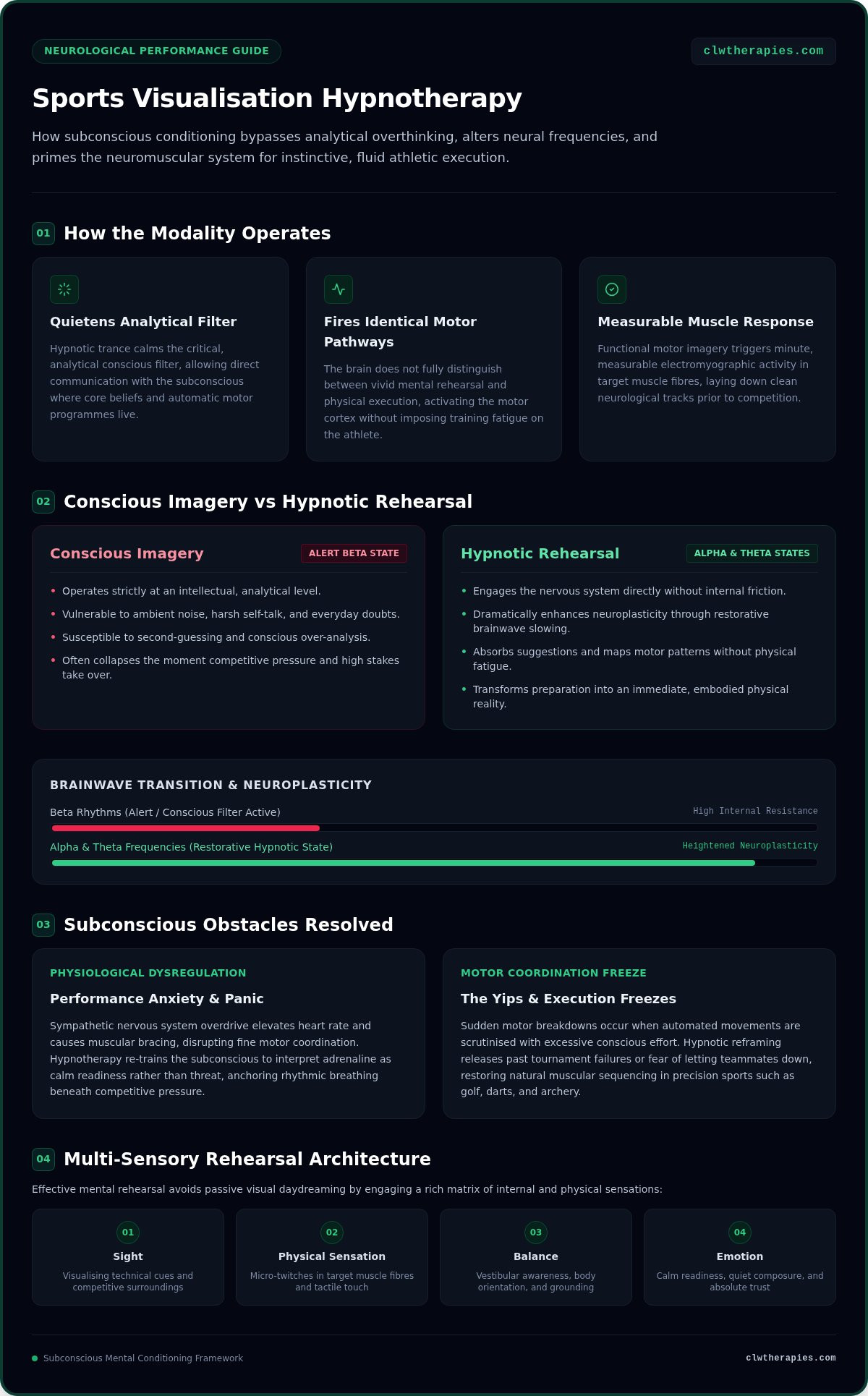
Sports visualisation hypnotherapy is a specialised mental conditioning practice that merges a relaxed trance state with vivid, multi-sensory rehearsal to activate the motor cortex and prime physical movement. Rather than treating mental imagery as passive daydreaming, this modality creates direct neurophysiological engagement. The brain does not fully distinguish between a vividly imagined action and its physical execution. As established in the wider field of sports hypnosis, guiding an athlete into a focused state allows the brain to map motor patterns without the physical fatigue of training.
Hypnotic trance gently quietens the critical, analytical filter of the conscious mind. By entering this calm state, you access the subconscious directly, where core beliefs, instinctive habits, and automatic motor programmes live. Athletes use sports visualization hypnotherapy to sharpen technical movements, accelerate reaction times, and cultivate an unshakeable sense of composure when competing.
The Difference Between Conscious Imagery and Hypnotic Mental Rehearsal
Conscious visualisation often falls short because everyday doubts, ambient noise, and harsh self-talk easily interrupt it. Sitting on a bench trying to force positive pictures can feel like an uphill battle. Hypnotherapy shifts brainwave patterns away from alert beta rhythms into restorative alpha and theta states. These slower frequencies dramatically enhance neuroplasticity, allowing the nervous system to absorb new mental suggestions without internal resistance.
- Conscious imagery: Operates at an intellectual level, remaining vulnerable to second-guessing and conscious over-analysis.
- Hypnotic rehearsal: Engages the nervous system directly, transforming mental preparation into an immediate, embodied physical reality.
How the Subconscious Mind Primes the Neuromuscular System
When you vividly imagine a specific athletic action within a hypnotic state, the brain fires identical motor pathways used in physical performance. Research into functional motor imagery shows that deep mental rehearsal triggers minute, measurable electromyographic activity within target muscle fibres. The muscles subtly receive the signal, firing microscopic twitches that mirror the real motion.
Repeating this process strengthens the synaptic pathways governing complex physical movements. Think of it as laying down clean neurological track. Once competition begins, your body executes the motion automatically, freeing you from conscious interference and returning you to natural, fluid play.
Key Performance Obstacles Resolved by Subconscious Visualisation
Competitive plateaus rarely stem from a sudden loss of physical skill. Instead, they usually reflect hidden protective mechanisms locked within your subconscious mind. When past errors or high stakes trigger perceived danger, your nervous system responds with involuntary muscular tension, cutting off access to your natural flow state. As highlighted in research shared by the official publication of APA Division 47, addressing these deeper psychological barriers is essential to facilitate peak athletic execution and break through persistent performance ceilings.
Eliminating In-Competition Performance Anxiety and Panic
Sympathetic nervous system overdrive elevates your heart rate and tightens your muscles, disrupting the delicate fine motor coordination required for elite competition. Sports visualization hypnotherapy trains your subconscious mind to interpret adrenaline as calm readiness rather than impending threat. Anchoring rhythmic breathing beneath competitive pressure softens physical bracing, giving you back full command over your focus during pivotal match moments.
Overcoming the Yips, Target Panic, and Execution Freezes
Few experiences feel as frustrating as the yips or target panic. These sudden motor breakdowns usually take root when an athlete begins scrutinising automated movements with excessive conscious effort. Hypnotic reframing identifies the initial emotional trigger behind the block, whether linked to a previous tournament failure or a fear of letting teammates down. Releasing these subconscious associations restores natural muscular sequencing in precision sports like golf, darts, and archery. Choosing dedicated sports visualisation and motivation therapy provides a safe, focused pathway to unpick those reflexive movement blocks.
Accelerating Injury Rehabilitation and Rebuilding Movement Confidence
Even after physical tissues heal completely, your subconscious mind often holds onto protective guarding behaviours. These defensive patterns subtly alter healthy biomechanics and invite secondary injuries. Mental rehearsal within a trance state keeps neuromuscular mapping active whilst you rest your body. By regularly experiencing fluid, pain-free movements in your mind, you systematically dissolve subconscious hesitation and step back into training with genuine self-trust.
The Multi-Sensory Architecture of an Effective Visualisation Protocol
Visualising a sporting victory in your mind sounds pleasant, but simple daydreaming rarely translates into athletic performance. Your brain encodes visceral physical sensations far more deeply than flat, detached visual images. To alter motor habits permanently, mental rehearsal must mirror competitive reality down to the smallest detail. Sports visualization hypnotherapy relies on structured frameworks such as PETTLEP, ensuring your physical stance, competitive environment, task specifics, timing, learning level, emotion, and internal perspective all work in unison.
Engaging Kinaesthetic and Somatosensory Cues in Trance
True mental rehearsal requires you to feel every phase of your movement. You must sense the tacky texture of your grip, the precise distribution of weight through your feet, and the shift in balance as you pivot. Auditory details matter just as much. The hollow thud of a ball against equipment, the roar of a crowd, and the whistle of the referee all prime your situational awareness. Somatosensory cues transform passive visualisation into neuromuscular training by engaging the exact sensory receptors your nervous system uses during live competition.
- Kinaesthetic feedback: Sensing joint angles, muscular engagement, and rhythm.
- Auditory elements: Processing ambient competitive sounds without breaking concentration.
- Emotional fidelity: Replicating the physical surge of adrenaline in a safe, controlled state.
Installing In-Game Anchors and Mental Reset Triggers
Pivotal moments during competition demand instant mental clarity. In high-pressure sport, you rarely have time to sit back and run through a lengthy relaxation routine. Hypnotherapy solves this problem by pairing a peak emotional state with an intentional physical trigger. Known as anchoring, this technique creates an automatic link between a deliberate tactile cue and immediate, unshakeable composure.
An anchor might be a subtle roll of the shoulders, adjusting a wristband, or gripping a piece of equipment with deliberate intent. Subconscious conditioning ensures this trigger works automatically, resetting your nervous system in less than two seconds following an error or bad call from an official. Instead of replaying the mistake, you return instantly to the task right in front of you.
What to Expect During a Sports Visualisation Hypnotherapy Session
A professional sports hypnotherapy consultation is methodical, collaborative, and entirely centred on your performance goals. Rather than dealing in vague relaxation, each step targets the exact mental mechanisms governing your competitive output. A structured session follows five clear stages:
- In-depth assessment: Mapping your sport's demands, specific technical hurdles, competitive pressures, and desired execution states.
- Guided induction: Quieting conscious chatter to establish a focused, relaxed trance state where neuroplasticity peaks.
- Root-cause discovery: Uncovering subconscious limiting beliefs, hidden self-doubt, or past competitive events causing mental friction.
- Multi-sensory rehearsal: Immersing your nervous system in vivid tactical scenarios using kinaesthetic, visual, and auditory cues.
- Strategic anchoring: Setting physical reset triggers and crafting personalised post-session audio tools to reinforce these pathways daily.
Uncovering Core Limiting Beliefs with Rapid Transformational Therapy
Athletes often mask deep-seated fears of failure or impostor syndrome behind meticulous perfectionism. Rapid Transformational Therapy (RTT) cuts beneath conscious reasoning to locate where those self-sabotaging patterns originated. Perhaps an overly critical early coach or a single humiliating mistake created a protective habit of hesitation. Liberating your subconscious mind from that old emotional weight clears the slate. You regain the mental freedom to compete without defending against past mistakes.
Collaborative Goal Setting and Trance Safety
Clinical hypnotherapy is always a partnership. You remain completely aware, in control, and able to speak throughout the entire session. Bespoke suggestions align directly with your sport, positional nuances, and personal style of play. Rather than leaving you spaced out, sports visualization hypnotherapy leaves you feeling mentally revitalised, sharp, and deeply grounded. Explore how tailored support from CLW Therapies unlocks mental clarity and primes your body for competition. To begin transforming your competitive focus, you can book an individual hypnotherapy session tailored entirely to your athletic demands.
Selecting a Qualified Sports Hypnotherapist to Support Your Ambitions
Stepping into high-stakes athletic competition requires mental conditioning tailored to high performance. Not all general hypnotherapy training equips a therapist to handle the intense physical and emotional demands of competitive sport. Choosing a qualified practitioner means finding someone who understands both the psychological pressure of crunch moments and the mechanics of motor skill execution.
Athletes benefit most from working with specialists trained in advanced modalities, such as Rapid Transformational Therapy, who treat each sportsperson as an individual. When delivered with precision, sports visualization hypnotherapy provides an empowering pathway to dissolve subconscious blocks and unlock genuine flow.
Essential Practitioner Standards and Experience
Before beginning your sessions, verify that the practitioner holds accredited professional training, active professional insurance, and adheres to strict ethical oversight. Vetting their background ensures you work within a safe, supportive, and dependable space.
- Athletic understanding: Look for someone who appreciates the physical sensations, pacing, and emotional toll of competition.
- Tailored methodology: Avoid generic, scripted recordings. Effective therapy demands a bespoke intervention built around your specific technical position and hurdles.
- Advanced qualifications: Certified RTT practitioners possess specialised tools to resolve root emotional causes rather than merely addressing surface-level stress.
Reinforcing Change: Bespoke Audio and Daily Mental Conditioning
True neuroplasticity relies on steady repetition. While an intensive session unlocks underlying blocks and primes neuromuscular pathways, cementing those new subconscious patterns requires consistent reinforcement. A dependable therapist will provide a personalised audio recording crafted directly from your session suggestions.
Listening to this tailored recording daily allows you to practise hypnotic mental rehearsal in the comfort of your home. Over three to four weeks, these guided suggestions consolidate into reflexive habits, transforming your pre-match preparation into an effortless mental routine. You step onto the field or court with quiet confidence, completely free from old self-doubts.
Ready to elevate your athletic mindset? Connect with CLW Therapies to discuss your ambitions and schedule a dedicated performance session designed around your sporting goals.
Step Into Competition With Quiet Composure
True athletic breakthroughs happen when rigorous physical training aligns with a calm, focused mind. When competitive pressure builds, you don't need to battle racing thoughts or second-guess your technical ability. By bypassing conscious interference, sports visualization hypnotherapy bridges the vital gap between training form and match-day execution. It allows you to release lingering self-doubt, dissolve technical hesitation, and trust your body to react instinctively during high-stakes moments.
Sustainable progress always comes from targeted mental conditioning shaped around your unique discipline. CLW Therapies is an established, certified RTT practitioner led practice delivering bespoke one-on-one sports visualisation protocols to help you dismantle limiting beliefs and anchor deep composure. With national UK online consultations available, dedicated support fits seamlessly around your demanding training schedule. Begin your journey to calm, unshakeable athletic focus with CLW Therapies and step into your next sporting challenge with quiet, enduring self-belief.
Frequently Asked Questions
Can sports visualisation hypnotherapy really improve physical motor skills?
Yes, sports visualization hypnotherapy directly enhances motor execution by activating the motor cortex and firing subtle neuromuscular signals without causing physical fatigue. When you rehearse complex athletic sequences in a hypnotic trance, your brain maps the required synaptic connections just as it would during physical practice. This reinforces muscle memory, smooths out technical timing, and ensures your physical movements flow instinctively during competition.
Will I lose conscious control or awareness during a sports hypnotherapy session?
No, you remain fully in control, aware, and able to speak throughout your entire session. Hypnotic trance is simply a state of calm, focused concentration rather than sleep or unconsciousness. You can hear everything the therapist says, assess the suggestions being offered, and stop the process at any point if you choose. The work is entirely collaborative and shaped around your personal comfort.
How does sports hypnotherapy differ from standard sports psychology?
Standard sports psychology primarily works at the conscious, cognitive level, whereas sports hypnotherapy targets the subconscious mind directly. Traditional approaches often teach conscious coping strategies, self-talk adjustments, and pre-performance routines. While useful, these techniques can falter when adrenaline spikes. Hypnotherapy reprograms the deeper, automatic emotional triggers and limiting beliefs that drive physical freezing, creating lasting behavioural change without constant mental policing.
How many sports visualisation hypnotherapy sessions will I need to see results?
Most athletes notice positive shifts in focus and composure after just one or two sessions, though the exact timeline depends on your individual goals. Because modalities like Rapid Transformational Therapy focus on uncovering the root cause of mental stalls quickly, change happens much faster than in traditional long-term therapy. Paired with daily listening to your bespoke audio recording, new neural pathways usually consolidate within several weeks of consistent practice.
Can hypnotherapy help resolve the yips or sudden performance blocks?
Yes, hypnotherapy is particularly effective for resolving the yips and sudden motor execution freezes. The yips typically develop when an athlete over-analyses an automated movement due to hidden anxiety or a past competitive failure. By entering trance, you can safely locate and neutralise the subconscious fear triggering this hyper-conscious interference. Releasing that tension frees the neuromuscular system to return to its natural, unforced flow.
Is sports visualisation hypnotherapy effective when conducted via online consultations?
Yes, sports visualization hypnotherapy is just as effective when delivered through online consultations. Hypnosis relies on auditory guidance and your own internal focus, which means physical proximity to the therapist is not necessary. Many athletes find it easier to relax deeply and absorb suggestions from their own familiar home environment. All you need is a stable internet connection, headphones, and a quiet space where you won't be disturbed.
What happens if I struggle to visualise clear pictures in my mind?
You don't need clear mental images to benefit, because athletic visualisation relies far more heavily on feeling and sensation than visual detail. Many successful competitors cannot picture crisp visual scenes in their mind's eye. Instead, your subconscious responds powerfully to kinaesthetic awareness, such as the weight of an implement, balance shifts, muscle tension, or ambient sounds. Your therapist tailors the rehearsal protocol to whichever sensory channels feel most natural and vivid to you.
